
Bridging The Gap: The Contract-To-Ledger Divide In Life Sciences
By Inga Orozco and Kristin Orrell

Life sciences companies operate at the leading edge of innovation, structuring high-value licensing, development, and outsourcing arrangements in a highly regulated environment. A persistent and often underappreciated financial reporting risk arises not in the laboratory but at the intersection of contract drafting and accounting interpretation.
Contracts typically are structured by legal teams to protect intellectual property and allocate risk, while accounting teams evaluate those same agreements under U.S. generally accepted accounting principles (GAAP). Even when objectives are aligned, contractual provisions can produce accounting outcomes that differ from the intended commercial narrative. A single clause change, often viewed as commercially routine, can alter the identification of performance obligations, shift the timing of revenue recognition, affect debt covenant calculations, or change key financial metrics.
When contract terms are not evaluated through an accounting lens prior to execution, organizations risk outcomes that are legally sound but economically misaligned or difficult to support under accounting and regulatory scrutiny.
Examples of a fictitious company, LSci Therapeutics (LSci), demonstrate how modest drafting variations can materially change accounting conclusions. While risks from material changes generally are understood in principle, they are assessed less frequently in the context of specific drafting decisions and their downstream financial reporting implications. In practice, the contract-to-ledger divide is driven not by structural complexity but by variations in language that might affect how arrangements are interpreted under U.S. GAAP.
The analysis focuses on three common arrangements: 1) how payment structures and contingent consideration affect revenue recognition timing, 2) how seemingly ancillary provisions can create or modify performance obligations, and 3) how governance and control terms influence principal-versus-agent conclusions and financial statement presentation.
Example 1: Exclusive License
Baseline scenario: LSci Therapeutics grants BigPharmaCo exclusive license rights to commercialize a late-stage therapeutic candidate. Under the agreement, LSci sells the exclusive commercialization rights for a fixed up-front and nonrefundable $10 million payment due at contract signing. The agreement contains no refund provisions, no continuing substantive obligations, and no royalties or further collaboration requirements.
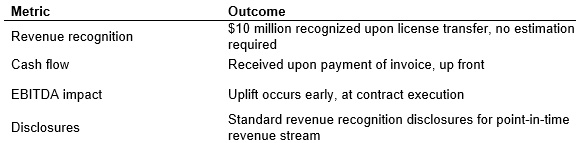
Under the revenue recognition rules of Accounting Standards Codification (ASC) Topic 606, the arrangement contains a single performance obligation: transfer of a functional intellectual property license. The $10 million contract price is satisfied at a point in time – specifically, when the license is transferred, according to the terms of the contract.
Result: The agreement reflects alignment between contract structure and accounting implications, with limited complexity, as follows:
Clause change: Revised timing and certainty of payments
Now consider the following change in contract terms: “LSci shall receive $8 million upon execution of the agreement and $2 million contingent upon Food and Drug Administration (FDA) approval.” All other pricing and economics remain consistent.
Unlike the baseline scenario, this modification changes the timing of revenue recognition and payments without introducing additional goods or services. Accordingly, the primary accounting consideration shifts to the evaluation of the $2 million of contingent consideration (referred to as variable consideration under Topic 606). In this situation, the constraint guidance under ASC 606-10-32-11 through 13 applies. The guidance notes that revenue is recognized “only to the extent that it is probable that a significant reversal in the amount of cumulative revenue recognized will not occur when the uncertainty associated with the variable consideration is subsequently resolved.” LSci faces two possible outcomes. The first is to record the variable consideration up front, assuming it is probable; however, reaching a probable conclusion when the contingency is outside of the company’s control often is difficult. The more likely conclusion is that the $2 million is fully constrained and, accordingly, no revenue is recorded until the constraint is lifted (typically, upon FDA approval).
Result: The following are potential financial reporting implications:
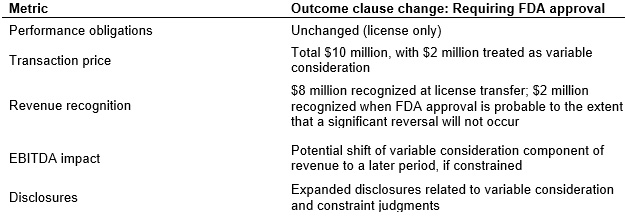
Even seemingly minor changes to contractual payment terms can materially affect the application of ASC 606. Introducing a contingent payment tied to FDA approval without altering the underlying promised goods or services can change the timing of revenue recognition (either in part or in full).
As the example demonstrates, small drafting differences in payment provisions can have a direct impact on revenue recognition, EBITDA timing, and disclosure requirements. This underscores the contract-to-ledger risk: Payment language that appears commercially routine might carry meaningful accounting consequences if not evaluated prior to execution. Close coordination between legal and accounting functions is therefore essential to verify that revenue recognition conclusions are technically supportable and that financial reporting faithfully reflects the substance of the arrangement.
Clause change: Addition of research and technical support services
Now consider further contract modification to include the following: “Following the effective date, LSci shall provide additional research and technical support services for a period of two years from the effective date of the agreement to support ongoing commercialization activities.”
This change introduces a new, enforceable, customer-driven promised good or service. From an accounting perspective, the addition of support services might represent a separate and distinct performance obligation. This affects:
- Identification of distinct performance obligations
- Allocation of the transaction price
- Assessment of timing of revenue recognition
- Development of methodology for over-time recognition
Result: The following are potential impacts:
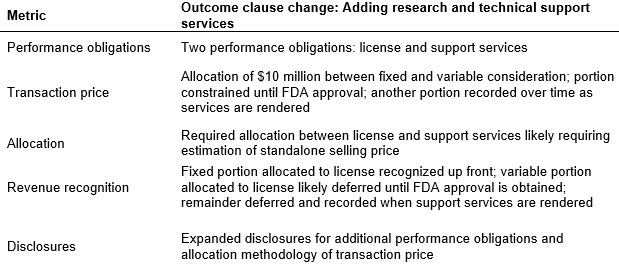
This example demonstrates how the addition of incremental, potentially “standard” provisions can materially alter accounting conclusions without significantly changing the core components of a transaction.
Example 2: Principal-Versus-Agent Considerations In CRO Arrangements
Beyond revenue timing and performance obligations, contractual language also can influence whether revenue is presented on a gross or net basis, typically when subcontractors are involved with the execution of a contract. The focus shifts to control — specifically, which party controls the service before it is delivered to the customer. In arrangements with contract research organizations (CROs), subtle drafting differences in governance or decision rights can materially affect the control assessment and, consequently, might affect whether the entity presents revenue on a gross (principal) or net (agent) basis.
Baseline scenario: LSci enters into an agreement with BigPharmaCo to conduct specified CRO activities. Under the arrangement, LSci operates as a CRO and assumes responsibility for planning, managing, and executing a clinical trial in accordance with applicable laws and regulations. As part of the agreement, certain subcontractors assist with the trials. LSci bears overall performance risk and is liable for deficiencies or nonperformance and has discretion to hire and oversee the activities of the subcontractors.
From a legal perspective, LSci is the primary obligor and bears operational and compliance risk of the trials. BigPharmaCo functions as the sponsor and customer of LSci, with LSci acting as a CRO.
Under ASC 606, the principal-versus-agent assessment focuses on whether LSci or the subcontractors control the services rendered to BigPharmaCo. Relevant indicators include which entity has primary responsibility for the activities performed and outcomes reached and whether LSci can replace the subcontractors.
In this example, LSci concludes it controls the CRO services:
- LSci is legally responsible for the performance and outcomes of the CRO activities; that is, BigPharmaCo views LSci as the party responsible for the contracted services, regardless of the use of subcontractors.
- LSci has the unilateral ability to replace subcontractors.
Result: Accordingly, LSci would be considered the principal for financial reporting purposes and, consequently, would report gross revenue.
Clause change: Revised descriptions of specific responsibilities
Now consider a change in the contract language whereby the agreement is revised to describe specific responsibilities of each party: “Work performed by the subcontractors listed in this agreement is subject to review and approval by BigPharmaCo. LSci is responsible for coordinating the timing and billing of the subcontractors’ services; any changes to the subcontractors or the scope of their work are the responsibility of BigPharmaCo.” This clause indicates that BigPharmaCo maintains control over the activities and outcomes of the subcontractors. LSci is performing coordination and billing services but is not taking responsibility for the subcontractors’ outputs. LSci’s role is more administrative and that of an agent versus a principal.
Result: Without changing pricing, scope, or economics, the shift in contractual language and operational authority changes the reporting conclusion to agent under ASC 606, materially affecting revenue presentation, margins, and key performance metrics, as summarized in the following table:
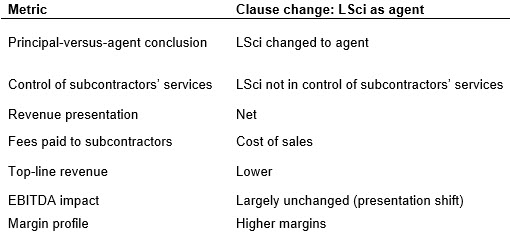
A principal conclusion increases reported revenue and cost of sales, altering margin profiles and growth trends, even if EBITDA and cash flows stay unchanged. An agent conclusion results in net revenue presentation, producing lower top-line metrics, higher margins, and different comparability outcomes. These differences could influence valuation assessments, revenue growth trends, covenant calculations, peer benchmarking, and investor perception.
From Illustration To Diagnosis: Identifying Root Causes
Although simplified, these examples demonstrate how contractual nuance can drive materially different financial reporting outcomes. The common thread is not technical complexity but governance failure — specifically, the absence of integrated decision-making at the point of contract formation.
The contract-to-ledger gap is most often driven by these root causes:
- Siloed decision-making. Legal, finance, and accounting functions operate sequentially rather than as an integrated deal team.
- Capacity and technical constraints. Lean teams might lack the bandwidth or expertise to evaluate judgment-intensive arrangements in real time.
- Fragmented governance. Unclear ownership, inconsistent review protocols, and weak escalation mechanisms reduce accountability and increase execution risk.
Closing The Gap: A Governance Framework
Mitigating these risks requires deliberate intervention at the drafting stage. Companies should consider:
- Coordinating finance, accounting, and legal at the term-sheet stage for nonstandard or high-impact arrangements
- Standardizing contract templates and clause libraries that align legal enforceability with accounting clarity
- Implementing formal review checkpoints with defined approval authorities and escalation pathways for complex transactions
- Enhancing board and audit committee visibility into high-impact contract arrangements
- Engaging technical accounting advisers proactively when transactions involve significant judgment
These actions are not a technical exercise; rather, they focus primarily on leadership responsibility. The takeaway is this: Accounting outcomes are shaped at the negotiation table, not after execution. Preventing unintended consequences requires discipline before the deal is signed.
Practical Pre-Execution Considerations
Before contract approval, companies should answer these questions:
- Have the finance and accounting functions substantively reviewed the draft?
- Have the accounting treatment and financial statement impact been formally evaluated?
- Does the legal language unintentionally alter revenue recognition, financial statement presentation, debt covenants, key performance indicators, or disclosure obligations?
- Are standardized templates and approval controls being used appropriately?
- Is the documentation sufficient to withstand audit and regulatory scrutiny?
- Does the agreement align with the company’s control environment and SOX framework (if applicable)?
- Does the transaction warrant audit committee visibility?
The contract-to-ledger gap is not an inevitable by-product of complex transactions; it is a function of when and how decisions are made. Organizations that integrate accounting insight into the drafting process position themselves to achieve not only compliance but also consistency, credibility, and control over their financial narrative.
About The Authors:
 Inga Orozco is a partner in the audit and assurance group at Crowe. She specializes in audit, internal controls, and IFRS accounting standards.
 Kristin Orrell is a partner in the accounting advisory group at Crowe. She specializes in technical accounting topics including revenue recognition, leasing, consolidation, and financial instruments.