
Why Life Sciences Demand Venture Formation Over Venture Capital
By William Garner, M.D.

For decades, the Silicon Valley playbook has dominated the narrative of innovation: a brilliant founder hacks together a minimum viable product in a garage, pitches a traditional venture capital (VC) firm, secures a seed round, and off they go. In the tech sector, this model works beautifully. The infrastructure is digital, the capital requirement to reach a beta test is relatively low, and the primary risk is market adoption.
But moving into the high-stakes world of life sciences, biotech, and deep tech, that traditional playbook has significant limitations.
As a physician and investor, I have spent years navigating the chasm between raw scientific discovery and commercial reality. At EGB Ventures, we routinely confront a fundamental truth: you cannot hack together a novel small-molecule oncology drug or a gene-editing platform in a garage. The timeline from a laboratory breakthrough to a Phase I clinical trial takes years and millions of dollars before a single patient is treated.
Because the landscape is drastically different, the investment model must be entirely different. This is the critical distinction between traditional venture capital and venture formation.
The Traditional VC Model: Picking The Horse
Traditional venture capital is fundamentally an exercise in selection and acceleration. In this model, the venture firm acts as a judge and a fueling station. An existing startup, with a formed management team, a clear business plan, and some level of initial proof-of-concept approaches the VC. The investor’s job is to conduct due diligence, assess the team’s capability, evaluate the market size, and write a check.
Once funded, the traditional VC provides board governance, strategic advice, and introductions to subsequent funding sources. However, the operational execution remains entirely on the shoulders of the founders who walked through the door. The VC has bought a ticket on the train; they are not laying the tracks.
The Venture Formation Model: Building The Engine
While traditional VC funds a company that already exists, venture formation creates a company that should exist. Venture formation is an exercise in creation and architecture. It does not look for existing companies to fund; it builds companies from scratch around nascent, breakthrough science.
In life sciences, groundbreaking discoveries often sit trapped inside academic institutions or research hospitals. The principal investigators who discovered these phenomena are brilliant scientists, but they are rarely corporate executives. They don't have a business plan, an executive team, a regulatory strategy, or a legal framework.
This is where venture formation steps in. Instead of waiting for a pitch deck, a venture formation firm proactively scours academia for intellectual property (IP). When we find a compelling mechanism of action or platform technology, we don't just write a check to the university. We license the IP and actively build the company from the ground up.
Venture formation involves a hands-on, heavy-lifting operational approach:
- Interim Leadership: The investment team often steps in as the initial C-suite, managing everything from corporate structuring to laboratory logistics.
- Assembling a Team: We recruit the seasoned drug developers, regulatory experts, and clinical operators needed to turn a bench science concept into an institutional-grade asset.
- De-risking the Science: We design and fund the precise, critical experiments needed to validate or kill a concept early, ensuring capital is deployed efficiently.
The Operational Divergence
The differences between these two approaches dictate how a company breathes, grows, and allocates capital in its earliest days.
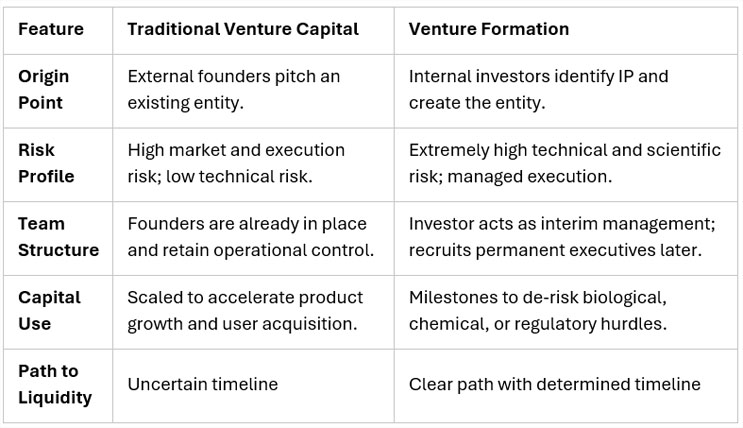
The Shift To Venture Formation Is Vital For The Future of Medicine
We are living in an era of unprecedented biological discovery, from CRISPR gene editing and mRNA platforms to AI-driven protein folding. Yet, the bottleneck to getting these therapies to patients isn't a lack of ideas or a lack of capital; it is a lack of translation.
Traditional venture capital is structured to avoid early-stage technical risk. If a breakthrough requires two years of basic translational work just to prove it works in an animal model, traditional VCs will often tell the founders to "come back when you have more data."
Venture formation leans directly into that technical risk. By pairing first institutional capital with operational, medical, and scientific expertise right at the inception point, we compress the timeline from lab bench to bedside. We ensure that world-changing science doesn't die in the university transfer office simply because the scientist didn't know how to navigate the FDA.
For investors, venture formation offers a way to manufacture alpha by getting in at the literal ground floor of proprietary technology. For society, it is the mechanism that turns raw human ingenuity into the next generation of life-saving therapeutics. It is no longer enough to merely fund the future: we have to build it.
About The Author:
 William Garner, M.D., is the founder and Managing Director of EGB Ventures, a venture formation and investment firm dedicated to advancing breakthrough life science technologies.