
BIO 2026: China, AI, And FDA

By Ben Comer, Chief Editor, Life Science Leader
Bouncing around the San Diego Convention Center’s 2.6 million square feet for four days is its own kind of flustery exercise, but in the age of Zoom it’s a more-than-welcome excursion. It’s hard to complain about a summertime work trip to San Diego.
BIO 2026 featured a mix of off-site events, onsite panels, scheduled and impromptu interviews, and some in-person Business of Biotech recordings (look out for those in the coming weeks, posted here). In the meantime, here are a few selected themes and tidbits from the meeting.
BIO ‘Aligned’ With Congress On Chinese Biotech
The rise of China’s biotech industry, and the percentage of overall global deal flow (upwards of 40% over the last 12 months) including Chinese companies — primarily in the form of out-licensed drug candidates — has heightened security concerns stateside.
From the bipartisan Biotech Investment National Security Act (H.R. 9102) introduced in early June, which would require U.S. Treasury Department review of licensing deals, joint ventures, and private equity investment in China, to the Select Committee on China’s epistolary probing of BMS and Merck in late June, it seems like the industry could be headed for a showdown on Capitol Hill.
Not so, countered BIO president and CEO John Crowley, during a Q&A with media during the conference. BioSpace’s Annalee Armstrong asked Crowley what he makes of the “adversarial tone” Congress appears to be taking on Chinese biotech dealmaking, to which Crowley responded: “I wouldn’t characterize Congress’s view as adversarial. We’re actually perfectly aligned.” Crowley added that biotechnology as a national security imperative is a “first principle” at BIO, a principle demonstrated by the organization’s support of the Biosecure Act’s passage last December.
“We need to make sure that we don't fall into the trap of what [China] is trying to create, which are these inescapable dependencies where more and more of [the biotech industry] becomes dependent,” continued Crowley. “I do worry about unintended consequences, and the effectiveness of trying to put bans in place,” he said. “We’ll come to a good solution, and BIO will, I’m sure, lead the way.”
NewCos With Chinese Assets
Still, the “speed of execution and meaningful improvements to medicines makes China a compelling partner,” said Ruchira Glaser, M.D., EVP, global head of cardiovascular, renal, and metabolism development at Novartis, on a panel on U.S.-Asia biotech dealmaking. Glaser pointed to the increasingly popular “NewCo” model of bringing Chinese development assets into a new company, or NewCo, and going public.
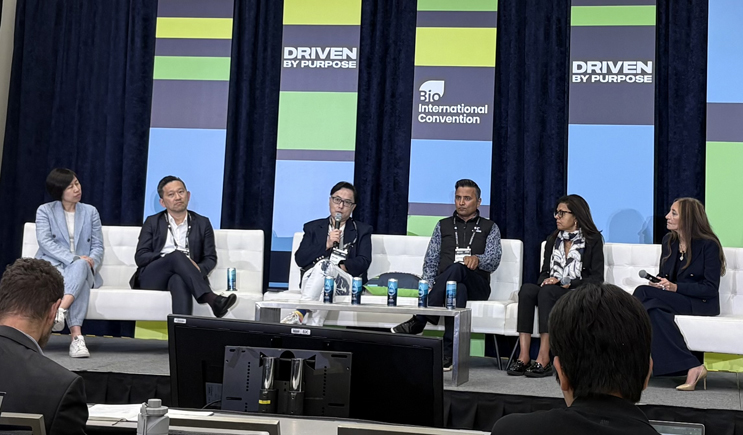
Glaser said the model was firmly established by Kailera Therapeutics, which was built from a NewCo (Hercules CM Newco) that licensed clinical-stage assets from China’s Jiangsu Hengrui Pharmaceuticals, changed its name to Kailera, and ultimately raised $625 million in an IPO last April. “China has structural advantages for doing discovery, preclinical and early clinical studies,” noted Jielun Zhu, cofounder, CFO, and CBO, Excalipoint Therapeutics. The NewCo model effectively “vets early-stage assets in China, then brings them to the U.S. for development.”
It’s not just NewCos scooping up Chinese development assets. In addition to licensing products for development and commercialization in the U.S. and Europe, Big Pharma is increasingly interested in commercial rights in China too, said Glaser. Right now, Chinese biotechs are only holding on to Chinese rights so they are eligible to do an IPO on the Hong Kong stock exchange, said Zhu. But the “new generation of Chinese biotech companies will sell those [China] rights, no problem…if the price is right,” he said.
Agentic AI ‘Ready’ For Life Sciences
Nvidia used the BIO meeting to launch its latest tool, or suite of tools, for life sciences companies (BioNeMo Agent Toolkit), and stupefied at least one life sciences editor with technical gobbledygook during an offsite breakfast presentation. I’d offer an overview on how this suite of tools works, and what it can do for life sciences companies, but I’m still stuck on Nemotron.
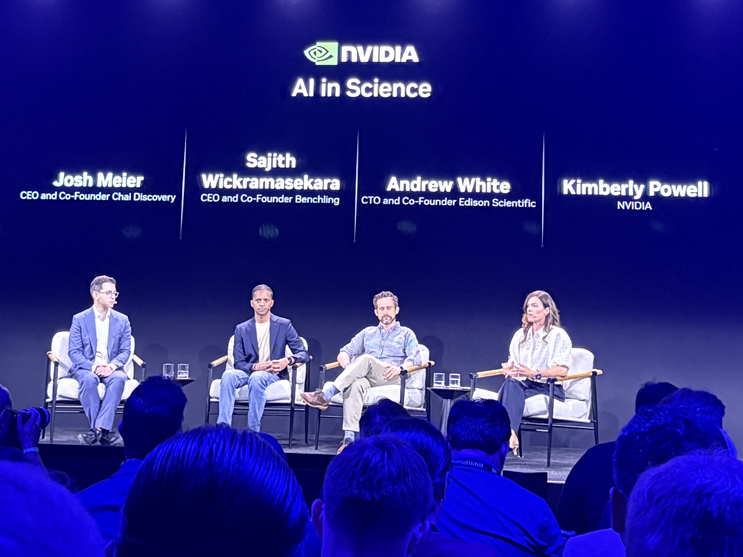
During a panel discussion following the toolkit launch announcement, Joshua Meier, cofounder at Chai Discovery and a former researcher and engineer at OpenAI and Facebook AI, said there are “more possible antibodies than atoms in the universe,” a claim at least two scientists couldn’t directly refute when queried about it afterward. The observable universe contains about 10⁸⁰ atoms, or 100 quinvigintillion atoms, per ChatGPT, so if Meier (and ChatGPT) is correct, at least 100 quinvigintillion (plus one) unique antibodies are out there waiting to be designed or discovered.
AI has moved on from aggregating as much scientific data and information as possible and then looking for connections that could identify new therapeutic approaches, a project that ultimately failed, said Andrew White, cofounder and CTO at Edison Scientific. Agentic AI is the future, allowing people and organizations to “build your own scientific reasoning brain,” said Kimberly Powell, Nvidia’s VP of healthcare and life sciences. With an agentic “lab in the loop” setup, autonomous AI agents create an iterative process that forms hypotheses, conducts experiments, analyzes results, and then repeats until a specified goal is reached.
On a separate panel moderated by veteran journalist Katie Couric, Ashley Magargee, CEO at Genentech described using the lab in the loop concept at Genentech (Nvidia and Genentech announced a partnership in 2023). The outcome specifics are a little hazy, but all of Genentech’s antibody programs, and ~90% of its small molecule programs, integrate AI “to streamline discovery, make design more predictive, and increase the likelihood of success,” according to a company white paper.
BIO 2026’s program had a dedicated AI track this year, the second year in a row, and while I didn’t have a chance to sit in on those panel sessions, AI still managed to locate a backdoor into plenty of other industry discussion topics.
FDA Town Hall: We’re Hiring
The FDA is “truly still underestimating what we can do with AI to expedite research … there are so many areas that we're still scratching the surface,” said Karim Mikhail, acting director at CBER and OTP, during an FDA Town Hall session moderated by Crowley. Mikhail described a scenario where AI was being used to read and analyze a drug developer’s non-clinical study slides, which can save time, he said. “But at the FDA, we're still not there [in terms of] accepting this type of technology, so there is a lot of room for us to advance and to use AI.”
The FDA panel, which included Mikhail along with Mike Davis, acting director at CDER, and Lowell Zeta, acting FDA chief of staff, agreed that FDA hiring and retention is at the top of the agency’s priority list right now. “Our hiring plan is over 2,200 [individual staffers],” said Zeta, who reports to Kyle Diamantas, FDA’s acting commissioner. “We’re at about 600 that are in onboarding and clearance at various levels, with a couple hundred already through the [hiring] process.”
On employee retention, “there is a lot of effort to minimize attrition … everybody who’s thinking of leaving is getting a meeting with an [agency] leader … to discuss how we can keep you, because you have expertise that we don’t want to lose,” said Mikhail. “We’re also being incredibly creative in terms of utilizing existing expertise in some teams. We get 5,000 INDs a year at the FDA, but they’re not distributed evenly across teams, so we’re being nimble as to what we can do to maximize the use of every member we have.”
At CDER, employee attrition rates have dropped back down to historical levels, said Davis. Now, “it’s a matter of really keeping and supporting and empowering the staff we have, and bringing new folks in.”
FDA Pilots And Reevaluating Rare Disease Drugs
The panel briefly discussed the HHS’s recently announced Operation Trialblazer program, which is aimed at maintaining U.S. leadership in early clinical R&D, and encompasses multiple governmental health agencies. At the FDA, Operation Trialblazer creates an expedited IND pilot program allowing for an “IND rolling submission in real-time, which will allow companies to … submit components [of an IND package], get feedback on them, and expedite the process overall,” said Mikhail. Drug developers interested in commenting on the expedited IND pilot program should do so by July 22, 2026.
Regarding FDA’s recent rare disease drug decisions, particularly a few Complete Response Letters (CRLs) that effectively blocked rare disease drug approvals over the last nine months — all of which happened prior to the departures of Vinay Prasad, director at CBER, and FDA Commissioner Martin Makary — Crowley asked the panelists about the mindset and rationale behind FDA’s decision to revisit rejections.
In 2026, leaders must be open to listening and revisiting agency decisions, said Mikhail. “It’s the only way to survive in today’s world.” The scientific views within the FDA are varied, and not everyone thinks the same way. But patient need must serve as the agency’s north star, said Mikhail. “What is the benefit/risk ratio? Do we have a chance to give this patient a chance, yes or no? Are we making sure that safety is paramount, and that everybody is on the same page with regard to a second chance? An adaptive framework is needed for rare diseases.”
Mikhail also pushed back on the perception that single actors — such as agency leaders — within the FDA can or should make autonomous decisions about drug approvals. “We cannot build a sustainable solution that is based on an individual, including me. If we really want to be a great FDA, it has to go beyond the people,” said Mikhail. “It cannot be because this person was there two or three years ago, and he or she used to say yes and take a phone call, and now there is a more difficult person … that’s not the FDA, that’s not the gold standard for regulatory science.”