
Galien Forum: CEOs Talk FDA, China, Funding Sources

By Ben Comer, Chief Editor, Life Science Leader
Recent reporting on FDA leadership and personnel issues, as well as the resignation of George Tidmarsh from his role as director at CDER, cast new light on FDA Commissioner Makary’s tenure at the agency, even as new, industry-desired pilot programs, AI adoption, and other changes go forward.
The first installment of this two-part editorial series covered Commissioner Makary’s in-person comments at the Galien Forum on October 30, regarding new ways to speed up the agency’s review and approval processes (including several pilot programs) and his stated disdain for “singing and dancing” DTC drug ads. This second installment covers a CEO roundtable discussion (about FDA, among other things), as well as Commissioner Makary’s comments about using AI at the agency and using tariffs to incentivize domestic pharmaceutical manufacturing.
Need For Speed And Most-Favored-Nation
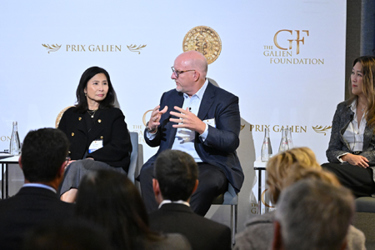
Leadership transition at Takeda is a slow process, by design. At the beginning of 2025, Takeda announced that Julie Kim, former president of Takeda’s U.S. business unit and now CEO-elect and interim head, global portfolio division, will become CEO when Christophe Weber, Takeda’s current CEO, retires … in June 2026. That 18-month period will give Kim plenty of time to get up to speed, but she was hopeful that the FDA can move a little faster. “What we hear from Commissioner Makary is encouraging, but funding and staffing [at FDA] is concerning,” said Kim during the CEO roundtable, adding that regulatory agencies in China, Japan, and Europe have improved. “Speed is important … for FDA, it’s about executing on Commissioner Makary’s public statements.”
Adding to that, Rob Davis, chairman and CEO at Merck & Co., said that it takes “twice as long to get a study started in the U.S.” compared with China. “They are doing high-quality studies [faster].”
On the Most-Favored-Nation Executive Order (MFN), Davis said that other countries “are not paying their fair share,” and that “importing foreign pricing … could have a detrimental impact.” However, FDA remains the gold standard, said Davis. “We still prioritize the U.S., even with MFN … the U.S. becomes more important.”
Funding Innovation
The speed and number of announcements coming out of the White House — and the resulting headlines and news flow that follows — can make it difficult for onlookers to know exactly how a given shift in policy may or may not impact the biopharmaceutical sector or individual companies.
Reductions in funding at academic institutions, for example, may be helping biotech, at least in the short term. “So much funding has come out of academia, that more academics are coming into biotechs,” said Angela Hwang, CEO and Partner, Flagship Pioneering, and CEO at Metaphore Biotechnologies, during the CEO panel.
When key pieces of the innovation ecosystem are under threat, it can create problems for the whole sector, said Davis, pointing to a strong science education system in the U.K., but “no money for biotech, and no pricing freedom.” Merck “is doing more deals with universities, and they are more willing now that public money is drying up,” he said.
Makary On AI And Tariffs
Prior to FDA Commissioner Makary’s appointment at the agency, there was talk and frameworks and panels and conferences and guidance, but no AI, said Makary. “We got a very powerful AI tool” — Elsa — “and we had a couple of scientific reviewers use it with their applications, to organize the applications, ensure formatting, pull in literature so they could get directed to the original article to look at the background on the disease or treatment, prior studies, and they could ask it questions, just like you might ask Google a question,” said Makary. “We started adding buttons for functions that FDA reviewers commonly perform, and people in the pilot loved it.”
Makary said the AI tool helped agency staff “do things in minutes that would normally take them days.” The AI tool was rolled out agency wide “for all of our scientific reviewers and staff, all 16,000 employees, ahead of schedule and under budget, and they loved it,” he said. By tracking unique daily users of the AI tool, Makary said that the “majority of people” doing scientific reviews are now using it. “We’re going to keep going and will add more functionality, as AI improves, to give them that power.”
On tariffs, Makary decried a situation where “for 35 years, the globalists allowed our manufacturing sector across the entire U.S. to get completely depleted, with national security risks completely ignored.” Now, however, is a “great time for manufacturing to come back to the United States. I believe interest rates are going to keep coming down,” said Makary, adding that automation in manufacturing has “reduced the delta on workforce savings” when companies take their business overseas.
“The president has used tariffs as a powerful tool to bring industry back to the United States,” said Makary. “It’s working, so we’re going to do everything we can to try to bring manufacturing back, and stick to our mission of trying to keep drug prices as low as possible.”
Click here to watch the full video of FDA Commissioner Martin Makary, M.D.’s comments at the Galien Forum.